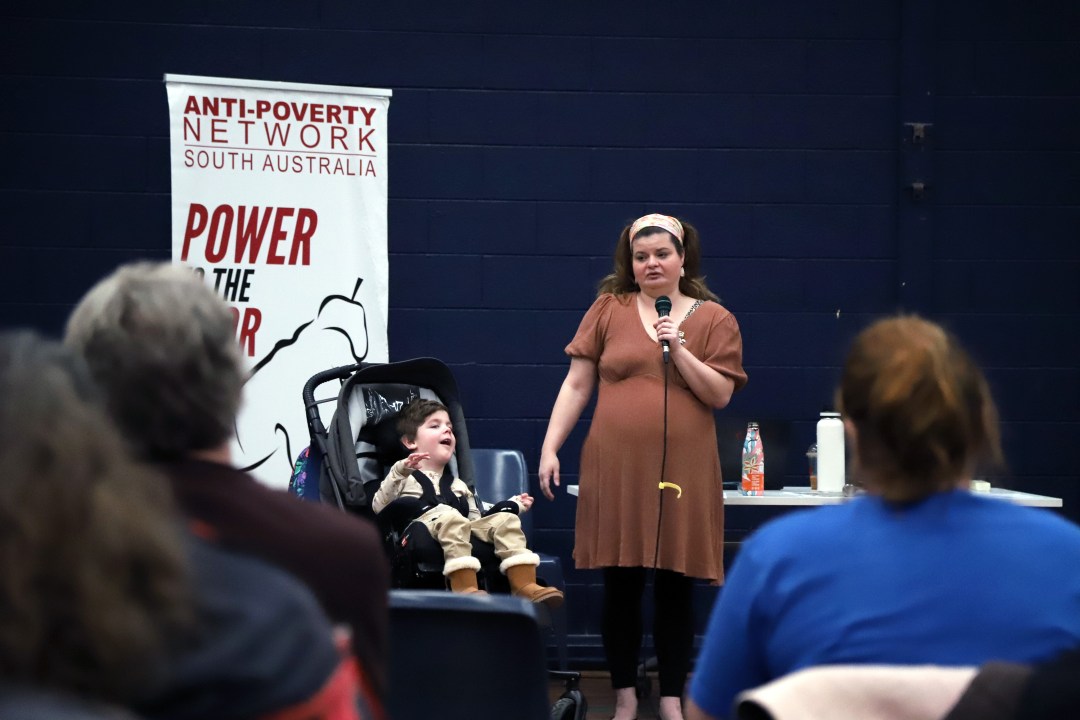
Speech by Katie to Anti-Poverty Network SA Kilburn Community Lunch and Meeting, September 28, 2024
I have been invited to share my experience with the public housing system in SA. Before I start, I wanted to introduce you to my co-speaker, Cassian. Cassian has a severe form of cerebral palsy and complex epilepsy. He requires substantial supports for every aspect of daily life, this includes a need for life-support equipment.
Cassian, myself and the rest of our family came very close to being homeless. As you can imagine, homelessness is a travesty for anyone, but for Cassian the consequences could have been fatal.
After a long fight we were eventually put onto category 1 for housing trust, however it became clear that we were no closer to being housed than when we first got on the list. At first were told that our housing issues were disability related and should be met by the disability sector. Cassian is too young for SDA and disability community housing organisations don’t generally have properties to house whole families.
We were referred to various organisations to help us find private rental, including a private rental access worker through Housing Trust themselves. None if which could help us because we had needs that couldn’t be met within the private rental market.
At one point I sent an email to Premier Malinauskas asking him what he would do if I my son died, freezing and struggling to breathe in a tent, and I was to place his cold, dead body at his feet? Would he step over that body on the way to yet another photo opportunity in front of his new sports stadium where he could brag about how much his constituents mean to him. Did he realise that I love my son just as much as he loves his children and that my children have just as much right to go to sleep at night, safe and warm? Did he care at all?
Eventually, as time was running out, I started to make plans for what homelessness might look like for us. I made a post on the Anti Poverty Network Facebook group asking for advice on how to manage homelessness with my son. I got a response from Sam who promised me I wasn’t alone, I did not have to accept this as an inevitability and to do more.
So I did more.
I made plans with the social worker connected to the complex care unit at WCH to fight to have my son admitted to hospital as a social patient, in a last ditch effort to keep him alive and healthy should the worst happen. I am sure we can all appreciate that while hospital is marginally better than a tent, it still isn’t home. He would be separated from his family and all that is familiar to him.
A lack of public housing almost ended up in either the death or serious ill-health of my child, or with me having no choice but to surrender my child to another state system in order to ensure his physical wellbeing. In this scenario, the state would have been complicit in separating a severely disabled, very young child from his mum and primary caregiver. What’s most ironic is that the cost of this separation and the ensuing irreparable harm it would have caused to the both of us, would have cost the state government more than the cost of building a brand new home.
I wrote an email to my housing case worker, begging for a shred of hope. Instead I got sent a list of ways to “manifest a house”. I was given some google links on where to purchase an affordable tent and where were the safest place to pitch a tent.
In the end, as many of you know, our story was picked up by the media and went viral. It was this high level of public scrutiny that led to our personal housing crisis getting the attention it needed.
I should note here that Cassian was a sympathetic character and our story was compelling due to the nature of the house manifestation emails we had received. Going to the media is so frequently the suggestion given, but yet is rarely the answer to solving a personal crisis. It is hard to make people care, even with a media story.
Successive governments have endeavoured relentlessly to privatise housing and to undermine our collective right to access a safe, secure home. We’ve all been subjected to propaganda designed to convince the populace that housing is a commodity to be fought for and ‘earned’, rather than a basic human right. But, when we commoditise a basic human right, we violate those same human rights.
Our story is one of hope, but also one which highlights the importance of activism, which often feels relentless and without reward. For every win, like ours, there are usually countless “losses”. I know that this is really disheartening.
I get it because until the media picked up my story, I had been advocating relentlessly for my son and feeling as though I was getting nowhere. I was screaming into the void.
I had to go scorched earth and get the media on side to share our story. Even then, the system and those propping it up bent and twisted itself like Nero in the Matrix to avoid any accountability.
My story was cherry picked and the underlying message lost. It became less about the systemic failures of a vital social safety net and more about the unfortunate emails that were sent by a public servant that made the SA Housing Trust look bad. The damage control team came in hard, the public servant was sent for ‘retraining’ and our politicians got to pat themselves on the back for being so swift in action. Like, let’s not fall over ourselves thanking them for their swift action in reprimanding a small, underpaid fish in a big, broken pond.
The smooth rhetoric of our politicians, propped up by assumptions and media clickbait ensured that the focus of the crisis was directed everywhere, except where it belonged. The public servant who sent the manifestation emails was maligned, the public went on a witch hunt of immigrants and asylum seekers, while people who have been criminalised or who are fighting addictions were vilified and blamed for “taking housing” from the “most deserving”. With so many different groups to blame it makes it harder for truth telling and fact checking to break through the noise. This is by design and intention.
But the truth is, I don’t blame the public servant, I don’t blame immigration and asylum seekers; and I certainly don’t blame others who are just as marginalised and victimised by our systems as we have been.
I want it to be known that despite the housing crisis setting us up as adversaries competing for limited resources, I do not and never have viewed other struggling people as an enemy or an adversary. We are in this together. Pitting various marginalised groups against one another is what they want, it enables and props up the system that hurts all of us. Division has long been the political weapon of choice, on both sides. But at the end of the day, human rights should not be political; they should be assumed and automatic.
The cause of our housing crisis is the decades upon decades of government neglect of public housing; the decimation of existing public housing stock and the lack of political will to provide enough public housing homes to GUARANTEE our human right to housing.
It was only through collective people power that we got offered the home we desperately needed. It was because a community of people who were invested in our story kept holding certain feet to the fire until something was done.
And it was done. We were offered 2 properties within a week of each other. The first property was unsuitable due to not having an appropriate bathroom for modifications. But the second one was perfect, with just a few minor modifications. We moved in last Monday and for the first time I feel safe, knowing my family is safe.
However, the reality is that Cassian is just one face of the housing crisis. We were lucky to have the resources to advocate so strongly and to go ‘scorched earth’ in that advocacy. However, for many this is not possible, and it shouldn’t be necessary.
That’s why we need to come together as a group; a collective, to demand better housing options for everybody. It’s not enough to tinker around the edges and build just a fraction of the new public housing homes that are needed simply to house those on category 1. We need tens of thousands more.
Government initiatives which only focus on private rental don’t help those whom are not able to access private rental. Affordable home ownership initiatives don’t help those who are unable to save for a deposit or to access a home loan.
There will always be real human beings within our society who have needs that are too complex to meet within a privatised rental market or through home ownership, yet these human beings still have a right to be housed.
We need to advocate for more public housing stock. This also means we need to work together to challenge the perception that staying out of homelessness is a personal responsibility. We need to change the way society views housing as a commodity and an income source, as opposed to a basic human right. There needs to be more public housing. The current investment, while welcome, is simply not enough.
The newest efforts by the SA government to build more public housing was because the housing crisis became too big to ignore. It began to impact the middle class and the “personal responsibility” propaganda lost much of its effectiveness. This means that right now we have momentum and we need to maintain this momentum and refuse to let them placate us with the bare minimum.
We can email MPs, continue sharing our stories, sign petitions, challenge misinformation online and in person. Just keep the pressure up and remind them again and again that we aren’t going away and we are not giving up.
I know it’s hard. In my fight for housing, I was called ungrateful, I was called entitled. I was belittled, bullied and demeaned online. My emotional health and wellbeing took a dive. I have never felt more vulnerable or exposed.
But, my experience also made me realise the privilege I had in being able to use the media to fight for my son’s rights. Not everyone can go to the media. Not everyone is articulate. Not everyone is a so-called sympathetic character in the way a severely disabled little boy is. If I was torn apart by the public, I can’t imagine the courage it would take for some people to tell their stories without a cute little side-kick to pull at people’s heart strings.
We ALL have the right to be housed. We ALL have the right to safe, secure, affordable housing regardless of income, family makeup or personal history. We shouldn’t all have to be sympathetic characters like Cassian in order to have our needs met.
I want the media attention we got to mean something. I intend to leverage it for all it’s worth. If Cassian needs to become one of the public faces of the housing crisis in order to make a difference, then so be it. If I need to stand up and speak for those who cannot, then I will. We’ve all got strengths, we’ve all got weaknesses; we’ve all got different privileges and face differing oppressions and that is why it is so important to come together and work collectively. Let’s go!
Thank you!!
Read more about Katie’s story here
 Anti-Poverty Network SA